
|
Getting your Trinity Audio player ready...
|
🔗 Blockchain Explained: A Beginner’s Guide to the Technology of Trust
Introduction
The word “blockchain” is everywhere—from cryptocurrency headlines to debates about the future of healthcare and finance. But what is blockchain really, and why does it matter? This article breaks it down in simple terms so anyone can understand how it works, why it’s important, and where it’s being used today.
What Is Blockchain Technology?
Blockchain is a digital ledger that records transactions in a secure, transparent, and tamper-proof way. Unlike traditional databases controlled by banks or governments, blockchain operates on a decentralized network of computers (nodes). Each transaction is grouped into a “block” and added to a continuous chain—making the record almost impossible to alter.
At its core, blockchain is a digital ledger—a way of recording information that is shared across many computers. Instead of a single entity (like a bank, company, or government) owning the record, blockchain is decentralized, meaning no one person or group has total control.
Think of it as a Google Doc: multiple people can view and update it at the same time, every change is tracked, and nothing can be deleted—only added. Once information is entered into the blockchain, it becomes permanent and tamper-proof.
How Blockchain Works
Blocks and Transactions
Each block contains transaction data, a timestamp, and a cryptographic reference to the previous block. Once a block is completed, it’s linked to the chain, creating a permanent and verifiable history of all transactions.
The Role of Decentralization
Instead of one central authority, blockchain is maintained by multiple participants. This system ensures no single entity has full control, making it more resistant to fraud and censorship. Learn more about cryptography in blockchain.
Each block contains transaction data, a timestamp, and a cryptographic reference to the previous block. Once a block is completed, it’s linked to the chain, creating a permanent and verifiable history of all transactions.
Benefits of Blockchain
-
-
Transparency: All participants can view records in real time.
-
Security: Advanced cryptography ensures data cannot be altered.
-
Efficiency: Transactions are faster and often cheaper by cutting out intermediaries. See how blockchain improves efficiency.
-
Trust: Because no single entity controls the data, blockchain fosters trust among strangers.
-
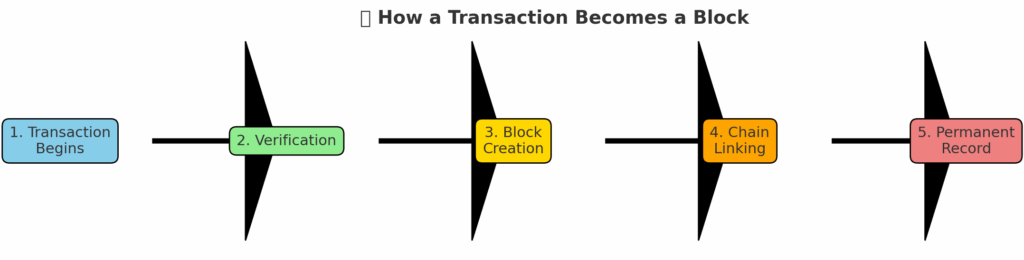
Blockchain technology follows a step-by-step process:
-
Transaction Begins – A person sends money, data, or digital assets.
-
Verification – A network of computers (called nodes) checks the transaction’s validity.
-
Block Creation – Once verified, transactions are grouped into a “block.”
-
Chain Linking – Each block is securely connected to the previous one.
-
Permanent Record – The block is added to the chain and cannot be altered.
Every block contains a digital fingerprint (called a hash) and a reference to the block before it. This linking system makes the entire chain secure and trustworthy.
Visual Guide to Blockchain
To make it easier to follow, here’s a step-by-step diagram of how a transaction becomes part of the blockchain:
-
See our Blockchain Glossary for definitions of key terms.
Vertical Flow
-
Transaction Begins
-
Verification
-
Block Creation
-
Chain Linking
-
Permanent Record
Horizontal Infographic

Color-Coded Process
-
🔵 Transaction Begins
-
✅ Verification
-
🟡 Block Creation
-
🟠 Chain Linking
-
🔴 Permanent Record
Why Blockchain Matters
Blockchain changes the way we think about trust and record-keeping. Instead of relying on middlemen—like banks to transfer money or governments to keep records—we can trust the technology itself.
-
Security: Data on blockchain is encrypted and distributed across many computers, making it nearly impossible to hack.
-
Transparency: Everyone in the network can see the same information.
-
Efficiency: Blockchain cuts out intermediaries, reducing cost and speeding up transactions.
Real-World Applications of Blockchain
Blockchain in Finance
From Bitcoin to banking, blockchain enables faster payments, identity verification, and fraud prevention. See our guide to blockchain and banking.
1. Cryptocurrency
Bitcoin, Ethereum, and other cryptocurrencies run on blockchain, allowing digital money to move securely without banks.
2. Healthcare
Hospitals are exploring blockchain to secure patient records, prevent prescription fraud, and improve data sharing. Read more about blockchain in healthcare.
3. Supply Chains
Companies use blockchain to trace goods, fight counterfeiting, and ensure ethical sourcing. PwC highlights supply chain use cases.
4. Voting Systems
Blockchain-based voting could create secure, tamper-proof elections.
5. Digital Identity
Blockchain helps people prove their identity online without relying on centralized services.
Advantages of Blockchain
-
Decentralization: No single point of failure.
-
Security: Resistant to hacking and fraud.
-
Immutability: Records cannot be changed once added.
-
Transparency: Open access to transaction history.
Challenges of Blockchain
Like any technology, blockchain isn’t perfect. Some challenges include:
-
Energy Usage: Mining (especially in Bitcoin) uses large amounts of electricity.
-
Scalability: Some blockchains struggle to process many transactions at once.
-
Regulation: Governments are still figuring out how to regulate blockchain.
-
Complexity: For many, blockchain is still hard to understand and adopt.
The Future of Blockchain
Blockchain is evolving beyond cryptocurrency. Governments are testing Central Bank Digital Currencies (CBDCs), industries are adopting smart contracts, and digital ownership through NFTs is reshaping art and media. As adoption grows, blockchain may become a foundation of digital trust. For a deeper dive, explore MIT Technology Review – Blockchain.
Experts believe blockchain will become the backbone of Web3, the next evolution of the internet, where data and digital ownership are decentralized.
Key Takeaways
-
Blockchain is a digital ledger that records transactions in a secure, transparent, and decentralized way.
-
It works by grouping verified transactions into blocks, linking them chronologically, and making them permanent.
-
Real-world applications include cryptocurrency, healthcare, supply chains, voting, and identity management.
-
While challenges like scalability and regulation remain, blockchain has the potential to reshape trust, transactions, and data in the digital age.
Final Word
Blockchain is more than a buzzword—it’s a transformative technology built on trust, security, and transparency. Whether in finance, healthcare, or global supply chains, blockchain is reshaping the way the world connects and shares information. Want to go further? Start with our Beginner’s Guide to Cryptocurrency.
📖 Want to keep learning? Explore more guides and resources on www.LoraineLindsay.com.
Disclaimer: The content on this website is provided for general informational and educational purposes only. While every effort is made to ensure accuracy, no guarantee is given that the information is complete, reliable, or up to date. The material is not intended as financial, medical, legal, or professional advice. Always seek the guidance of a qualified professional regarding any specific concerns. By using this site, you agree that the author and publisher are not responsible for any actions taken based on the information provided.